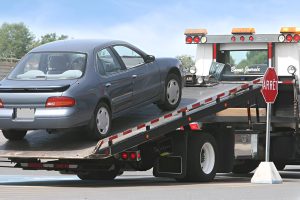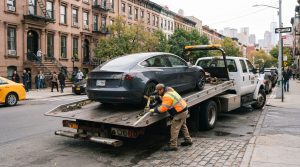

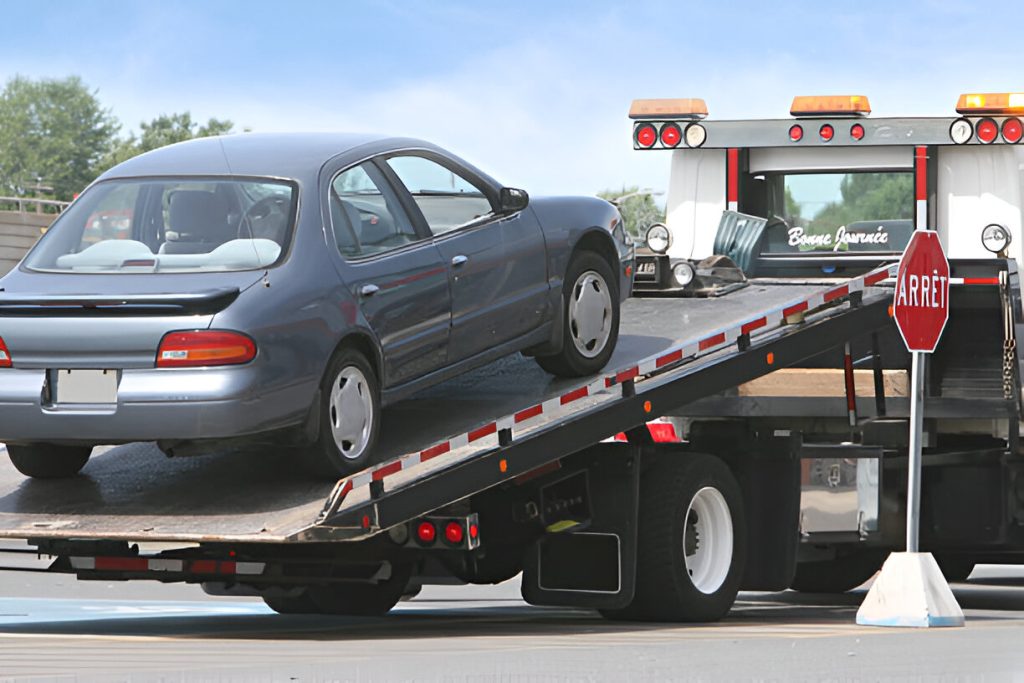
Parking on private property in New York City can lead to a tow even when the vehicle is there for only a few minutes. Shopping centers, private lots, apartment properties, and other privately controlled spaces can restrict parking to customers, residents, tenants, or authorized vehicles.
Understanding private property towing in NYC matters because these tows follow different rules from NYPD parking tows or sheriff and marshal enforcement. Private-property tow companies must follow city licensing requirements, posted parking rules, and legal rate caps, while drivers still have rights when retrieving the vehicle.
If your car disappears from a private lot, the first step is to determine who authorized the tow and where the vehicle was taken.
What Counts as Private Property Towing in NYC?
Private property towing happens when a vehicle is removed from land that is not part of the public street system.
Examples can include:
- Shopping center parking lots
- Apartment parking areas
- Private garages
- Business parking lots
- Private streets
- Commercial properties
The property owner or authorized operator may establish parking restrictions and use a licensed towing company to enforce them.
NYC’s Department of Consumer and Worker Protection licenses towing companies that remove vehicles from private property.
Private Property Towing Is Different From an NYPD Tow
It is important to identify which type of tow happened because retrieval rules and fees are different.
Private Property Tow
Usually initiated by a private property owner or operator after a vehicle violates posted rules.
NYPD Tow
Can happen for reasons such as:
- Illegal street parking
- Invalid registration
- Lack of insurance
- Other enforcement situations
Sheriff or Marshal Tow
Can happen when the registered owner owes a qualifying parking or camera judgment debt.
If you are unsure who towed the car, NYC advises using the city’s towed-vehicle resources or contacting 311.
Posted Signs Matter Before a Vehicle Is Towed
Private parking rules should be clear enough for drivers to know who can use the property.
NYC consumer guidance specifically warns that if a private parking lot has a sign stating that parking is reserved for customers and you visit another business, your vehicle may be towed even if you were gone only briefly.
Before Leaving a Car in a Private Lot, Look for
- Customer-only parking rules
- Resident or tenant restrictions
- Permit requirements
- Time limits
- Towing warnings
- Name of the towing company
- Contact number
Do not assume a mostly empty lot means public parking is allowed.
The restriction can still be enforced.
A Sign Can Also Help You Find the Car After a Tow
When a vehicle has been removed from a shopping center or other private property, NYC recommends looking for the posted towing sign and contacting the company listed there.
If no sign can be found, contact the local police precinct.
This helps you determine whether the vehicle was legally towed, relocated, or potentially stolen.
Private Property Tow Companies Must Be Licensed
New York City requires towing companies handling private-property tows to be licensed by DCWP.
The towing truck itself must display identifying information.
Look for
- Company name
- Company address
- Phone number
- DCWP license medallion
DCWP states that the license medallion should appear on the driver’s side of the tow truck. A truck performing regulated towing without the required identifying information may be unlicensed or violating city licensing rules.
Tow truck drivers must also carry their own DCWP tow truck driver licenses.
Record the Truck Information if You Witness the Tow
If you arrive while your vehicle is being connected or transported, note:
- Company name
- Medallion number
- Driver information
- Truck plate
- Location
- Time
Take photographs where it is safe to do so.
These details can be useful if a dispute develops later.
NYC Caps Private Parking Lot Towing Fees
A tow company cannot charge any amount it wants for a regulated private parking lot tow.
As of August 2026, NYC’s current private parking lot rate caps are:
| Charge | Maximum Rate |
| Towing plus first 3 days of storage | $125 |
| Storage from the 4th day onward | $15 per day |
| Drop fee | $62.50 |
These rates are published by DCWP.
The First Three Days of Storage Are Included
This is an important distinction.
For a qualifying private parking lot tow, the $125 cap includes both:
- Towing
- First three days of storage
A company should not simply add another daily storage charge on top of that for the first three days.
What Is a Drop Fee?
A drop fee can apply when you return while the vehicle is about to be towed and the towing company releases it instead of completing the tow.
The current NYC private-lot drop-fee cap is $62.50.
This can save both time and money if the car has not yet been fully removed.
Tow Companies Cannot Demand Cash Only
A towing company should not force you to pay only in cash.
DCWP says licensed towing businesses must accept credit cards for towing services.
Be Cautious if You Are Told
- Cash is the only payment option.
- Credit card costs a large, unexplained surcharge.
- No receipt will be provided.
- Fees cannot be itemized.
Keep records of every payment made.
If you pay cash, save the receipt and any ATM withdrawal record connected with the transaction.
Always Get a Receipt
Documentation becomes important when you believe the tow or charges were improper.
DCWP advises consumers to keep receipts, invoices, correspondence, and copies of any forms connected with towing.
A Useful Tow Receipt Should Identify
- Towing company
- Company contact information
- License information
- Tow charge
- Storage charge
- Any additional fee
- Payment amount
Never sign a blank form.
If you sign any paperwork, get a copy before leaving.
What Should You Do if You Return While the Car Is Being Hooked Up?
Stay calm and ask whether the vehicle can be released for the legal drop fee.
Do not physically interfere with the tow truck or equipment.
Document the Situation
If possible, record:
- Current position of the car
- Tow truck company
- Time
- Posted parking sign
- Driver’s name or license number
If a dispute arises later about whether the tow had already begun or what fee was charged, those records may help.
How Do You Retrieve a Car Towed From Private Property?
Start with the towing sign posted at the property.
Call the listed company and ask:
- Where the vehicle is stored
- Current total amount due
- Accepted payment methods
- What identification is needed
- Storage hours
- What documents are required
Bring Vehicle Documentation
Requirements can vary, but it is useful to have:
- Driver’s license
- Vehicle registration
- Proof of insurance
- Ownership information
Call first rather than arriving without the necessary paperwork.
Retrieve the Vehicle Quickly to Avoid More Storage Charges
Waiting can make the tow more expensive.
The first three days of storage are included in the current $125 private-lot tow cap, but beginning on day four, storage can cost up to $15 per day.
Example
Suppose the vehicle remains stored for six days.
Potential capped charges could include:
- Tow + first three days: $125
- Days four through six: $45
Total: $170
Additional lawful charges may depend on the situation, but unexplained fees should be questioned.
Check the Car for Damage Before Leaving the Tow Yard
A vehicle can sometimes be damaged during towing, loading, or storage.
Inspect it before driving away.
Look at
- Bumpers
- Wheels
- Tires
- Body panels
- Undercarriage where visible
- Mirrors
- Steering operation
Take clear photos if something appears new.
If you already had photos from before the tow, they can help establish the vehicle’s previous condition.
Remove Valuable Items Before a Voluntary Tow, but Private Tows Are Different
With an unexpected private-property tow, you may not have a chance to remove belongings first.
When retrieving the vehicle, check the interior and trunk.
If personal property is missing, document it immediately and ask the facility about its procedures.
Keep a written record of who you spoke with.
What if You Believe the Tow Was Illegal?
A tow can be disputed when you believe the towing company violated city rules.
Potential concerns can include:
- No applicable parking restriction
- Missing required towing information
- Unlicensed towing company
- Excessive fees
- Cash-only demand
- Improper drop-fee handling
- Failure to provide required documentation
DCWP accepts complaints about towing companies and tow truck drivers.
Preserve Evidence Before Filing a Complaint
Take or keep:
- Photos of parking signs
- Photos of where the vehicle was parked
- Receipt
- Tow invoice
- Credit card statement
- Truck medallion number
- Driver’s license information
- Emails
- Text messages
- Notes from phone calls
DCWP explains that complaints can still be submitted without documentation, but receipts and supporting records are important if you want mediation or a refund.
What if There Was No Towing Sign?
Do not immediately assume the car was stolen.
NYC recommends contacting the local police precinct if a vehicle disappears from private property and there is no towing sign identifying the company.
You can also contact 311 if you are unsure which agency may have removed the vehicle.
Check More Than One Possibility
The car might have been:
- Privately towed
- NYPD towed
- Relocated
- Towed by another enforcement agency
- Stolen
Confirm the tow before traveling to any storage facility.
Private Property Booting Is Different From Towing
Some private properties use wheel boots instead of immediately towing a vehicle.
NYC regulates private-property booting separately.
According to DCWP, the booting company must:
- Be properly licensed
- Remove the boot within 30 minutes after contact and payment
- Accept credit card
- Charge no more than $25 for removal
If the vehicle is booted, look for the posted sign identifying the booting company.
Do not try to drive with the boot attached.
Blocking a Private Driveway Follows Different Rules
A car blocking someone’s driveway is not treated exactly like a customer parking violation inside a private commercial lot.
NYC directs property owners and drivers dealing with blocked-driveway towing to contact the local police precinct.
The current rate cap for towing a vehicle that blocks a driveway is:
- $125 plus tax for towing and the first three days of storage
- $15 per day beginning on the fourth day
Do not confuse this with the private parking lot tow rules, even though the amounts are similar.
Private Property Towing Is Not the Same as Accident Towing
If a car is towed after an accident in NYC, different rules can apply.
DCWP regulates programs such as the Directed Accident Response Program, or DARP, for qualifying accident tows.
That type of tow comes with its own:
- Authorized towing process
- Paperwork
- Rate caps
- Destination rights
A shopping-center tow does not automatically follow the DARP rules.
Knowing why your car was towed is therefore essential before challenging the charge.
What Drivers Should Check Before Parking on Private Property
Avoiding the tow is easier than disputing one later.
Before Walking Away From the Vehicle
- Look for towing signs.
- Confirm whether parking is customer-only.
- Check time limits.
- Check permit requirements.
- Make sure you are visiting the property the lot serves.
- Do not assume after-hours parking is allowed.
- Avoid fire lanes and restricted areas.
The fact that other cars are parked there does not prove your vehicle is authorized.
What to Do After a Private Property Tow
Use this sequence.
Step 1: Check the Parking Sign
Find the towing company name and contact number.
Step 2: Confirm the Vehicle Location
Call the towing company. If no sign exists, call the local precinct or 311.
Step 3: Ask for the Current Charges
Compare them against the NYC rate caps.
Step 4: Retrieve the Vehicle Promptly
Avoid additional storage days.
Step 5: Inspect the Vehicle
Take photos before leaving if there is possible damage.
Step 6: Keep All Documents
Save the receipt and payment records.
Step 7: File a Complaint if Necessary
Contact DCWP if you believe the tow company violated NYC towing rules.
Know the Rules Before Paying a Private Property Tow
Private property towing in NYC follows city rules that protect both property owners and vehicle owners. A vehicle parked contrary to posted private-lot restrictions can be removed, but the towing company must operate within NYC licensing and rate requirements. Current rules cap a qualifying private-lot tow and the first three days of storage at $125, storage after that at $15 per day, and the drop fee at $62.50.
If your vehicle needs towing for a breakdown, collision, relocation, or other authorized situation, we provide towing and roadside assistance throughout New York City. You can contact us for towing service when you need help moving a disabled or damaged vehicle safely.