
Towing an electric car isn’t like towing a regular one, and a lot of drivers don’t find that out until they’re standing on the side of a Brooklyn or Queens road watching a truck pull up. Should the wheels touch the ground? Does the battery need to be turned off? Can just any driver hook it up? These questions confuse people, and honestly, they should.
An electric vehicle carries a battery pack with hundreds of volts running through it, plus a motor that can act strangely if the wheels spin the wrong way. Good tow truck services in NYC solve this by using flatbeds, checking the battery status, and following the steps written in each car’s manual. This article explains how that process actually works, from prep to final delivery.
Why EVs Require a Different Approach to Towing
A gas car can often be pulled with its wheels rolling, since the engine sits disconnected from the axles once it’s off. An EV doesn’t get that luxury. Its motor stays wired to the wheels even in neutral, so spinning wheels can send power back through a system that was never meant to receive it. That single difference changes almost everything about how the tow has to happen.
| Factor | Traditional Gas Vehicle | Electric Vehicle |
| Wheels touching ground during tow | Often fine, depending on drivetrain | Should not happen; motor can generate power |
| Neutral gear | True mechanical neutral | Many EVs lack a true neutral state |
| Tow method | Hook and chain, dolly, or flatbed | Flatbed only, in almost every case |
| Main risk | Transmission wear | High-voltage battery and motor damage |
| Pre-tow steps | Shift to neutral | Power down, locate approved tow points, check for warning lights |
| Warranty impact | Rarely affected by tow method | Improper towing can void drivetrain or battery coverage |
How Tow Operators Prepare an EV for Safe Transport
Before an EV ever touches the flatbed, a trained operator runs through a short list of checks. Skipping even one of them can lead to a fried inverter or a battery pack that no longer holds a full charge. This isn’t guesswork built on habit from towing sedans for years. It’s a sequence built around how the car’s electronics actually behave once the ignition goes off. The following process reflects the procedures used to reduce those risks during transport:
Turning Off the EV Completely
The first move is shutting the vehicle down fully, not just putting it in park. An EV that’s still partially powered can keep sending signals to the motor or the battery management system, which creates confusion once the car starts moving on the truck bed. Operators also disable any remote start features through the app if the owner mentions one is active. This single step prevents the motor from reacting to phantom commands while it’s strapped down and immobile.
Locating Manufacturer-Approved Tow Points
Every EV has specific spots built into the frame where lifting or strapping is safe. Grab the wrong spot, and you risk crushing a battery casing or bending a control arm that costs thousands to replace. Reliable tow truck services in NYC keep quick-reference charts for common EV models, since a Tesla’s tow points sit in different places than a Hyundai Ioniq’s. Guessing here isn’t an option when the underside houses cooling lines and battery cells just inches away.
Engaging Neutral or Transport Mode
Some EVs offer a software-based transport mode that disconnects the motor from the wheels temporarily, similar in purpose to a traditional neutral gear. Operators access this through the infotainment screen or a diagnostic tool, following steps unique to that brand. Without it, even a flatbed tow carries some risk if the vehicle rolls even briefly on its own power. A car left in this mode for too long can also drain its 12-volt battery, so timing matters here too.
Checking for Warning Lights or Battery Damage
Before loading, a quick walk-around checks the dashboard for active fault codes and scans the underbody for dents, scrapes, or fluid leaks near the pack. Battery enclosures can suffer hidden damage from potholes or minor collisions that owners never noticed. If something looks off, a cautious operator will document it with photos and flag it before moving the car, since towing a vehicle with a compromised pack raises the odds of thermal issues later.
Securing the EV at the Wheels
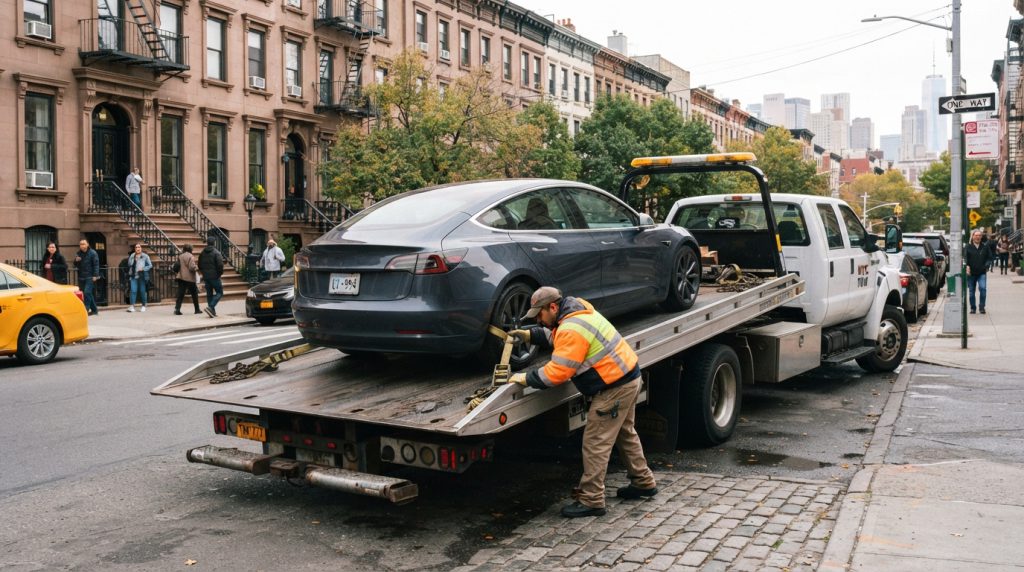
Straps go around the tires themselves, never around the axle, suspension arm, or battery shielding. Wheel-strap systems distribute pressure evenly and keep the car from shifting during turns or sudden stops on city streets. Chains or hooks that clamp onto structural points can crack a battery tray that sits just millimeters away. This method also protects the alignment, which matters since EVs often run tighter tolerances than older gas models.
Final Flatbed Safety Check
Once loaded, the operator checks strap tension, confirms all four wheels sit flush against the bed, and verifies the parking brake or wheel chocks are holding. A second look at the dashboard confirms the car powered down cleanly and isn’t drawing on the 12-volt battery unnecessarily. This last pass catches the small mistakes, a loose strap or a light left on, before the truck ever pulls into traffic.
Why Flat Towing and Dolly Towing Are Never Used on EVs
Flat towing drags a car with all four wheels on the pavement, and dolly towing lifts just the front or rear axle while the other wheels roll free. Both methods work fine on plenty of gas cars, but neither belongs anywhere near an electric vehicle. The reasons come down to how EV drivetrains and batteries actually function, not just outdated caution. See what happens when someone tries it anyway.
Wheel Rotation Can Cause Damage
When an EV’s wheels spin while the car sits off, the motor gets forced into acting like a generator, producing electricity with nowhere safe for it to go. That stray voltage can overheat motor windings or damage the inverter that manages power flow. Repair bills for this kind of failure often reach five figures, which is a steep price for a shortcut that saves maybe twenty minutes on a tow.
EV Drivetrains Aren’t Built for Towing
Traditional drivetrains include mechanical parts designed to disconnect the engine from the wheels. Electric motors, by contrast, stay coupled to the axle through a single-speed gearbox with no clutch to separate them. Dragging the car forces that gearbox to spin at speeds it was never engineered for outside normal driving, which wears down bearings and gears far faster than anyone would expect from a short tow.
Most EVs Don’t Have a True Neutral
Neutral on a gas car physically disconnects the transmission. Many EVs simulate neutral through software instead, and that simulation doesn’t always stop the wheels from feeding energy back into the system. Without a genuine mechanical brake, rolling the wheels on the ground still carries risk even if the dashboard shows a neutral indicator, which is part of why manuals for nearly every EV brand insist on flatbed transport only.
Longer Tows Increase Overheating Risk
A short roll across a driveway might not cause visible harm, but a multi-mile tow on dollies or flat behind a truck gives heat time to build inside the motor and gearbox. That heat can degrade windings, damage bearings, and stress the inverter that regulates current. The longer the distance, the greater the odds that a car towed improperly will show electrical faults days or weeks later.
These Methods Can Void Your Warranty
Manufacturers write towing instructions directly into their service documents for a reason, and most explicitly state that flat towing or dolly towing an EV isn’t covered. If a dealer later traces motor or battery damage back to an improper tow, the owner can be stuck paying for repairs that would have otherwise been free. Insurance companies sometimes push back too, if the towing method clearly ignored the manual’s instructions.
How Towing Companies Handle High-Voltage Battery Risks
EV battery packs run between roughly 400 and 800 volts, enough to cause serious injury if handled carelessly. Trained crews use insulated tools and non-conductive straps whenever they work near the pack or exposed cabling, and they avoid touching any orange-coded high-voltage components without proper gear.
If a vehicle has been in a collision or shows signs of battery damage, such as swelling, unusual smells, or warning codes, operators keep the car at a safe distance from buildings and other vehicles during transport and storage, since a damaged lithium-ion pack can develop stranded energy that leads to reignition even hours or days after an incident. Reputable services also inspect underbody panels for dents near the pack before moving the car, and they follow OEM guidance on isolating the high-voltage system.
Questions to Ask Before Hiring an EV Tow Truck in NYC
Not every towing company handles electric vehicles the same way, and asking a few pointed questions before the truck arrives can save a driver from a costly mistake. A dispatcher’s quick answers to the following questions usually reveal how much real experience the crew has with EVs specifically:
- Do you use flatbed trucks for every EV tow, with no exceptions?
- Are your drivers trained on locating manufacturer-approved tow points for different EV brands?
- What steps do you take if my car shows a warning light or battery damage before loading?
- Do you carry insulated tools and non-conductive straps for high-voltage systems?
- How do you secure the vehicle, at the wheels or somewhere else?
- What happens if my EV’s battery is completely drained when you arrive?
Looking for Safe EV Towing? A1 Towing & Collision Inc is Here to Help
Electric vehicles need careful handling from the moment a truck arrives to the second they’re unloaded, and that’s exactly what our crew is trained to deliver. A1 Towing & Collision Inc uses flatbed equipment for every EV we transport, checks manufacturer tow points before anything gets strapped down, and inspects each battery pack for warning signs before the drive begins. As one of the reputable tow truck services in NYC that understands high-voltage systems, we treat your EV the way its manufacturer expects. Call us the next time your electric vehicle needs a lift, and let our team handle the rest.